
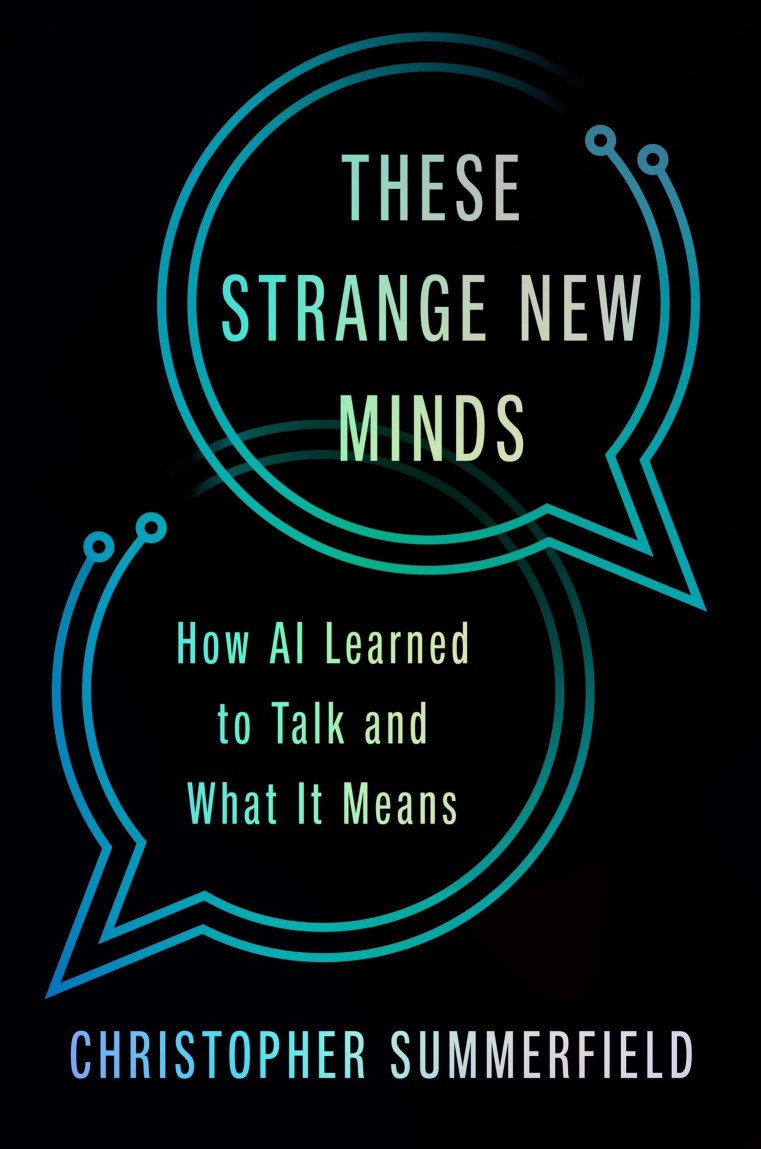
Читать книгу - "Эти странные новые разумы: Как ИИ научился говорить и что это значит - Кристофер Саммерфилд"
Kim, G., Baldi, P., and McAleer, S. (2023), ‘Language Models Can Solve Computer Tasks’. arXiv. Available at http://arxiv.org/abs/2303.17491 (accessed 11 December 2023).
Klessinger, N., Szczerbinski, M., and Varley, R. (2007), ‘Algebra in a Man with Severe Aphasia’, Neuropsychologia, 45(8), pp. 1642–8. Available at https://doi.org/10.1016/j.neuropsychologia.2007.01.005.
Kocijan, V. et al. (2023), ‘The Defeat of the Winograd Schema Challenge’. arXiv. Available at http://arxiv.org/abs/2201.02387 (accessed 17 February 2024).
Kojima, T. et al. (2023), ‘Large Language Models Are Zero-Shot Reasoners’. arXiv. Available at http://arxiv.org/abs/2205.11916 (accessed 11 December 2023).
Krueger, D., Maharaj, T., and Leike, J. (2020), ‘Hidden Incentives for Auto-Induced Distributional Shift’. arXiv. Available at http://arxiv.org/abs/2009.09153 (accessed 24 November 2023).
Lenat, D. (2022), ‘Creating a 30-Million-Rule System: MCC and Cycorp’, IEEE Annals of the History of Computing, 44(1), pp. 44–56. Available at https://doi.org/10.1109/MAHC.2022.3149468.
Lewis, P. et al. (2021), ‘Retrieval-Augmented Generation for Knowledge-Intensive NLP Tasks’. arXiv. Available at http://arxiv.org/abs/2005.11401 (accessed 9 December 2023).
Li, Y. et al. (2022), ‘Competition-Level Code Generation With AlphaCode’, Science, 378(6624), pp. 1092–7. Available at https://doi.org/10.1126/science.abq1158.
Lin, S., Hilton, J., and Evans, O. (2022), ‘TruthfulQA: Measuring How Models Mimic Human Falsehoods’. arXiv. Available at http://arxiv.org/abs/2109.07958 (accessed 7 October 2023).
Linzen, T., Dupoux, E., and Goldberg, Y. (2016), ‘Assessing the Ability of LSTMs to Learn Syntax-Sensitive Dependencies’, Transactions of the Association for Computational Linguistics, 4, pp. 521–35. Available at https://doi.org/10.1162/tacl_a_00115.
Liu, T. and Low, B. K. H. (2023), ‘Goat: Fine-Tuned LLaMA Outperforms GPT-4 on Arithmetic Tasks’. Available at https://doi.org/10.48550/arXiv.2305.14201.
Lobina, D. (2023), ‘Artificial Intelligence [sic: Machine Learning] and the Best Game in Town; or How Some Philosophers, and the Bbs, Missed a Step’, 3 Quarks Daily, 13 February. Available at https://3quarksdaily.com/3quarksdaily/2023/02/artificial-intelligence-sic-machine-learning-and-the-best-game-in-town-or-how-some-philosophers-and-the-bbs-missed-a-step.html.
Lu, Y., Yu, J., and Huang, S.-H. S. (2023), ‘Illuminating the Black Box: A Psychometric Investigation into the Multifaceted Nature of Large Language Models’. arXiv. Available at http://arxiv.org/abs/2312.14202 (accessed 17 February 2024).
Luccioni, A. S. and Viviano, J. D. (2021), ‘What’s in the Box? A Preliminary Analysis of Undesirable Content in the Common Crawl Corpus’. arXiv. Available at http://arxiv.org/abs/2105.02732 (accessed 6 October 2023).
Luria, A. R., Tsvetkova, L. S., and Futer, D. S. (1965), ‘Aphasia in a Composer’, Journal of the Neurological Sciences, 2(3), pp. 288–92. Available at https://doi.org/10.1016/0022-510X(65)90113-9.
Madaan, A. et al. (2022), ‘Language Models of Code Are Few-Shot Commonsense Learners’. arXiv. Available at https://doi.org/10.48550/arXiv.2210.07128.
Mahowald, K. et al. (2023), ‘Dissociating Language and Thought in Large Language Models: A Cognitive Perspective’. arXiv. Available at http://arxiv.org/abs/2301.06627 (accessed 16 September 2023).
Marcus, G. (2020), ‘The Next Decade in AI: Four Steps Towards Robust Artificial Intelligence’. Preprint. arXiv. Available at http://arxiv.org/abs/2002.06177 (accessed 8 April 2021).
Matz, S. et al. (2023), ‘The Potential of Generative AI for Personalized Persuasion at Scale’. Preprint. PsyArXiv. Available at https://doi.org/10.31234/osf.io/rn97c.
McCulloch, W. S. and Pitts, W. (1943), ‘A Logical Calculus of the Ideas Immanent in Nervous Activity’, Bulletin of Mathematical Biophysics, 5, pp. 115–33. Available at https://doi.org/10.1007/BF02478259.
Metzinger, T. (2021), ‘Artificial Suffering: An Argument for a Global Moratorium on Synthetic Phenomenology’, Journal of Artificial Intelligence and Consciousness, 08(01), pp. 43–66. Available at https://doi.org/10.1142/S270507852150003X.
Mialon, G. et al. (2023), ‘Augmented Language Models: A Survey’. arXiv. Available at http://arxiv.org/abs/2302.07842 (accessed 11 December 2023).
Michel, J.-B. et al. (2011), ‘Quantitative Analysis of Culture Using Millions of Digitized Books’, Science, 331(6014), pp. 176–82. Available at https://doi.org/10.1126/science.1199644.
Mikolov, T. et al. (2013), ‘Distributed Representations of Words and Phrases and Their Compositionality’. arXiv. Available at http://arxiv.org/abs/1310.4546 (accessed 18 February 2024).
Miller, B. A. P. (2015), ‘Automatic Detection of Comment Propaganda in Chinese Media’. Preprint. SSRN Electronic Journal. Available at https://doi.org/10.2139/ssrn.2738325.
Minsky, M. and Papert, S. (1969), Perceptrons: An Introduction to Computational Geometry. Cambridge, Ma: MIT Press.
Moskal, S. et al. (2023), ‘LLMs Killed the Script Kiddie: How Agents Supported by Large Language Models Change the Landscape of Network Threat Testing’. arXiv. Available at http://arxiv.org/abs/2310.06936 (accessed 17 December 2023).
Mosteller, F. and Wallace, D. L. (1963), ‘Inference in an Authorship Problem’, Journal of the American Statistical Association, 58(302), p. 275. Available at https://doi.org/10.2307/2283270.
Nakano, R. et al. (2022), ‘WebGPT: Browser-Assisted Question-Answering with Human Feedback’. arXiv. Available at http://arxiv.org/abs/2112.09332 (accessed 9 December 2023).
Newell, A., Shaw, J. C., and Simon, H. A. (1959), ‘Report on a General Problem-Solving Program’. Available at http://bitsavers.informatik.uni-stuttgart.de/pdf/rand/ipl/P-1584_Report_On_A_General_Problem-Solving_Program_Feb59.pdf.
Noy, S. and Zhang, W. (2023), ‘Experimental Evidence on the Productivity Effects of Generative Artificial Intelligence’, Science, 381(6654), pp. 187–92. Available at https://doi.org/10.1126/science.adh2586.
OpenAI (2023), ‘GPT-4 Technical Report’. arXiv. Available at http://arxiv.org/abs/2303.08774 (accessed 7 October 2023).
Ord, Toby (2020), The Precipice: Existential Risk and the Future of Humanity. London: Bloomsbury.
Ouyang, L. et al. (2022), ‘Training Language Models to Follow Instructions with Human Feedback’. arXiv. Available at http://arxiv.org/abs/2203.02155 (accessed 26 November 2022).
Owen, C. M., Howard, A., and Binder, D. K. (2009), ‘Hippocampus Minor, Calcar Avis, and the Huxley–Owen Debate’, Neurosurgery, 65(6), pp. 1098–105. Available at https://doi.org/10.1227/01.NEU.0000359535.84445.0B.
Pan, Y. et al. (2023), ‘On the Risk of Misinformation Pollution with Large Language Models’. arXiv. Available at http://arxiv.org/abs/2305.13661 (accessed 26 October 2023).
Pariser, Eli (2011), The Filter Bubble: What the Internet is Hiding from You. London: Viking.
Patterson, F. G. (1978), ‘The Gestures of a Gorilla: Language Acquisition in Another Pongid’, Brain and Language, 5(1), pp. 72–97. Available at https://doi.org/10.1016/0093-934X(78)90008-1.
Perez, E. et al. (2022), ‘Discovering Language Model Behaviors with Model-Written Evaluations’. arXiv. Available at http://arxiv.org/abs/2212.09251 (accessed 22 October 2023).
Phuong, M. and Hutter, M. (2022), ‘Formal Algorithms for Transformers’. Available at https://doi.org/10.48550/arXiv.2207.09238.
Piantadosi, S. T. (2023), ‘Modern Language Models Refute Chomsky’s Approach to Language’. LingBuzz. Available at https://lingbuzz.net/lingbuzz/007180.
Piantadosi, S. T. and Hill, F. (2022), ‘Meaning Without Reference in Large Language Models’. Available at https://doi.org/10.48550/arXiv.2208.02957.
Press, O. et al. (2023), ‘Measuring and Narrowing the Compositionality Gap in Language Models’. arXiv. Available at http://arxiv.org/abs/2210.03350 (accessed 13 December 2023).
Ravuri, S. et al. (2021), ‘Skilful Precipitation Nowcasting Using Deep Generative Models of






Прочитали книгу? Предлагаем вам поделится своим впечатлением! Ваш отзыв будет полезен читателям, которые еще только собираются познакомиться с произведением.
Оставить комментарий
- Тата15 октябрь 06:48Любовь через развод - Женя ГромоваНе понравилось. Для 28 лет, да ещё и завуча школы, героиня слишком тупая..
- Вероника08 октябрь 13:31Моя истинная попаданка - Наталья БулановаЗдравствуйте.Прочитала с интересом о том что можно разделить себя чтобы не терять две цели и к чему это может привести. Единственное что не понравилось это то что
- Гость Елена22 сентябрь 22:55Академия Сердцеедов. Обман - Полина ВерховцеваВсе три книги Полины Верховцевой понравились, спасибо большое автору и за возможность прочитать полностью.
- Нина15 сентябрь 06:23Решение первокурсницы - Аня СоколС удовольствием перечитала серию "Первокурсница" Ани Сокол. Получила огромную радость от новой встречи с героями книги.