
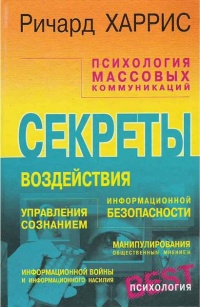
Читать книгу - "Психология массовых коммуникаций - Ричард Харрис"
Harris, R.J. (1981). Inferences in information processing. In: G. H. Bower (Ed.). The psychology of learning and motivation (Vol. 15, p. 82–128). New York: Academic Press.
Harris, R. J., Dubitsky, T. M., Bruno, K. J. (1983). Psycholinguistic studies of misleading advertising. In: R. J. Harris (Ed.). Information processing research in advertising. 241–262). Hillsdale, NJ: Lawrence Eribaum Associates.
Harris, R. J., Karafa, J. A. (1999). A cultivation theory perspective of worldwide national impressions of the United Slates. In: Y. Kamalipour (Ed.). U. S. image around the world: A multicultural perspective. Albany, NY: State University of New York Press.
Harris, R. J., Trusty, M. L., Bechtold, J. L, Wasinger, L. (1989). Memory for implied versus directly asserted advertising claims. Psychology Marketing, 6, 87–96.
Hart, R. P. (1994). Seducing America: How television charms the modem voter. New York: Oxford University Press.
Hass, R. G. (1981). Effects of source characteristics on cognitive responses and persuasion. In: R. E. Petty, T. M. Ostrom, T C. Brock (Eds.). Cognitive responses in persuasion (p. 141–172). Hillsdale, NJ: Lawrence Eribaum Associates.
Hatfield. E., Cacioppo, J. T. Rapson, R. L. (1992). Primitive emotional contagion. In: M. S. Clark (Ed.). Review of personality and soda/psychology: Vol. 14. Emotions and social behavior. Newbury Park , CA : Sage.
Hawkins, R. P.. Kirn, Y.-H., Pingree, S. (1991). The ups and downs of attention to television. Communication Research, 18, 53–76.
Hawkins, R. P., Pingree, S. (1990). Divergent psychological processes in constructing social reality from mass media content. In: N. Signorielli M. Morgan (Eds.). Cultivation analysis (p. 35–50). Newbury Park , CA : Sage.
Hayes, D., Birnbaum, D. W. (1980). Preschoolers' retention of televised events: Is a picture worth a thousand words? Developmental Psychology, 16, 410–416.
Healy, J. (1990). Endangered minds: Why our children's don't think. New York : Simon Schuster.
Hearold, S. (1986). A synthesis of 1043 effects 6f television on social behavior. In: G. Comstock (Ed.). Public communication and behavior (Vol. I, p. 65–133). Orlando , FL : Academic Press.
Heath, R. L., Bryanl, J. (1992). Human communication theory and research: Concepts, contexts, and challenges. Hillsdalc , NJ : Lawrence Eribaum Associates.
Heath, Т . В ., Mothersbaugh, D. L., McCarthy, M. S. (1993). Spokesperson effects in high involvement markets. Advances in Consumer Research, 20, 704–707.
Hebditch, D., Anning, N. (1988). Porn gold: Inside the pornography business. London : Faber Faber.
Heritage, J. (1985). Analyzing news interviews: Aspects of the production of talk for an overhearing audience. In: T. A. van Dijk (Ed.). Handbook of discourse analysis (Vol. 3. p. 95–117). London : Academic Press.
Herman, E. S., Chomsky. N. (1988). Manufacturing consent: The political economy of the mass media. New York : Pantheon.
Herman, E. S., O'Sullivan, G. (1989). The terrorism industry: The experts and institutions that shape our view of terror. New York: Pantheon.
Hinck, E. A. (1992). Enacting the Presidency: Political argument. Presidential debates, and Presidential character. Westport, CT: Praeger.
Hirschberg, M. S. (1993). Perpetuating patriotic perceptions: The cognitive function of the Cold War. Westport, CT: Greenwood.
Hoover, S. M. (1988). Mass media religion. Newbury Park, CA: Sage.
Hoover, S. M., Lundby, K. (Eds.) (I 997). Rethinking media, religion, and culture. Thousand Oaks, CA: Sage.
Hopkins, R., Fletcher, J. E. (1994). Electrodermal measurement: Particularly effective for forecasting message influence on sales appeal. In: A. Lang (Ed.). Measuring psychological responses tomedia (p. 113–132). Hillsdale. NJ: Lawrence Eribaum Associates.
Howitt, D. (1982). Mass media and social problems. Oxford, England: Pergamon Press.
Huesmann, L. R., Eron, L. D. (1986). Television and the aggressive child. Hillsdale, NJ: Lawrence Eribaum Associates.
Huston, A. C., Wright. J. C. (1987). The forms of television and the child viewer. In: G. A. Comstock (Ed.). Public communication and behavior (Vol. 2, p. 103–159). New York: Academic Press.
Jiyama, Р ., Kitano, H. H. L. (1982). Asian-Americans and the media. In: G. L. Berry C. Mitchell-Kernan (Eds.). Television and the socialization of the minority child (p. 151–186). New York: Academic Press, Ilola, L. M. (1990). Culture and health. In: R. W. Brislin (Ed.). Applied cross-cultural psychology (p. 278–301). Newbury Park, CA: Sage.
Intons-Peterson, M. J., Roskos-Ewoldsen, B. (1989). Mitigating the effects of violent pornography. In: S. Gubar J. Hoff-Wilson (Eds.). For adult users, only. Bloomington: Indiana University Press.
Jackson, D. Z. (1989, January 22). Calling the plays in black and white. The Boston Globe, p. A30–A33.
Jacoby, J., Hoyer, W. D. (1987). The comprehension and miscomprehension of print communication: A study of mass media magazines. Hillsdale, NJ: Lawrence Eribaum Associates.
Jamieson, K. H. (1992). Packaging the Presidency: A history and criticism of Presidential campaign advertising (2nd ed.) New York: Oxford University Press.
Jamieson, K. H., Campbell, К . К . (1992). The interplay of influence: News, advertising, politics, and the mass media (3rd ed.). Belmont, CA: Wadsworth.
Janis, I. L. (1980). The influence of television on personal decision making. In: S. B. Withey R. P. Abeles (Eds.). Television and social behavior (p. 161–189). Hillsdale, NJ: Lawrence Eribaum Associates.
Jhally, S., Lewis, J. (1992). Enlightened racism: The Cosby Show, audiences, and the myth of the American dream. Boulder, CO: Westview Press.
Johnson, D., Rimal, R. N. (1994, July). Analysis of HIV/AIDS television public service announcements around the world. Paper presented at International Communication Association meeting, Sydney, Australia.
Johnson-Cartee. K. S., Copeland. G. A. (1991). Negative political advertising: Coming of age. Hillsdalc, NJ: Lawrence Eribaum Associates.
Johnson-Cartee, K. S., Copeland, G. A. (1997). Manipulation of the American voter. Political campaign commercials. New York: Praeger.
Johnston, J., Ettema. J. (1982). Positive images: Breaking stereotypes with children's television. Beverly Hills, CA: Sage.
Johnston, J., Ettema, J. S. (1986). Using television to best advantage: Research for prosocial television. In: J. Bryant D. Zillmann (Eds.). Perspectives on media effects (p. 143–164). Hillsdale, NJ: Lawrence Eribaum Associates.
Jowett. G. S. (1993). Toward a propaganda analysis of the Gulf War. In: B. S. Greenberg W. Gantz (Eds.). Desert Storm and the mass media (p. 76–98). Cresskill, NJ: Hampton Press.





Прочитали книгу? Предлагаем вам поделится своим впечатлением! Ваш отзыв будет полезен читателям, которые еще только собираются познакомиться с произведением.
Оставить комментарий
- Тата15 октябрь 06:48Любовь через развод - Женя ГромоваНе понравилось. Для 28 лет, да ещё и завуча школы, героиня слишком тупая..
- Вероника08 октябрь 13:31Моя истинная попаданка - Наталья БулановаЗдравствуйте.Прочитала с интересом о том что можно разделить себя чтобы не терять две цели и к чему это может привести. Единственное что не понравилось это то что
- Гость Елена22 сентябрь 22:55Академия Сердцеедов. Обман - Полина ВерховцеваВсе три книги Полины Верховцевой понравились, спасибо большое автору и за возможность прочитать полностью.
- Нина15 сентябрь 06:23Решение первокурсницы - Аня СоколС удовольствием перечитала серию "Первокурсница" Ани Сокол. Получила огромную радость от новой встречи с героями книги.